
What is the main function?
The first function which is called when you run a program in any programming language is the main function. Python specifically does not have the Python’s main function as it is an interpreter language but we can create the main function and run it when the python file is run using special variable __name__. Let us first see what is __name__
To understand better, let’s explore Python’s main() Function and its significance in program execution.
__name__ is a special variable
Python automatically makes __name__ = “__main__” as you can see below
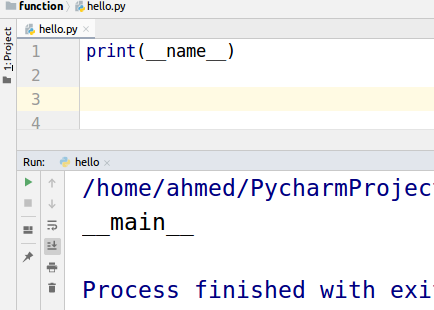
The usage of Python’s main() Function is vital for managing code execution effectively.
By defining Python’s main() Function, we set a clear entry point for our program.
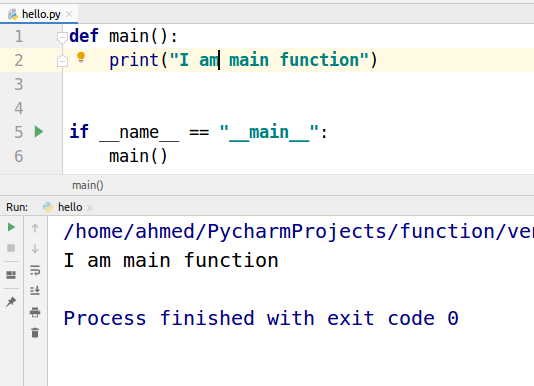
So we will write a condition to check whether __name__ == __main__ then call the Python’s main function. This checking will make sure that this hello.py is running this script. We will take a deep look into this when we will discuss importing other files than you will be able to see the importance of this.
def main():
	print("I am main function")


if __name__ == "__main__":
	main()
Utilizing Python’s main() Function allows developers to maintain clean and structured code.
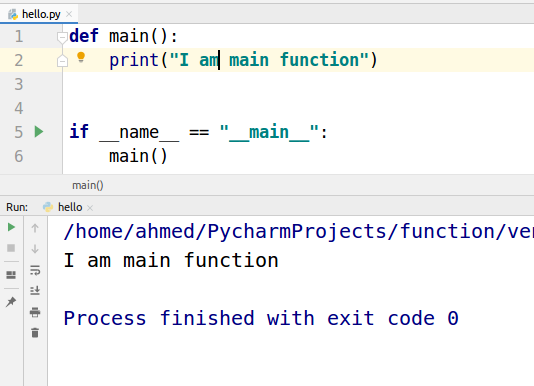
This is especially relevant when discussing Python’s main() Function in the context of module imports.
Understanding Python’s main() Function enhances our ability to write better Python scripts.
We can call different functions from the main functions. Let’s have a look at the example.
Thus, mastering Python’s main() Function is essential for effective Python programming.
With Python’s main() Function, developers gain structured control over script execution.
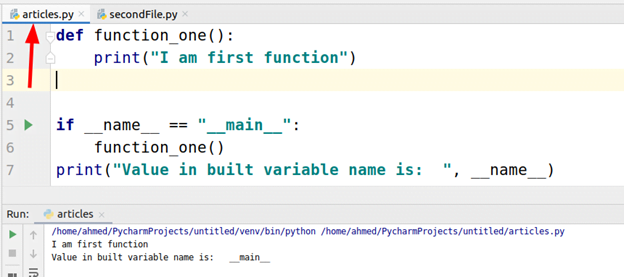
Understanding __name__ == “__main__”
Take a look at the screenshot below. When we run the articles.py file __main__ is set to “__name__”
Therefore, knowing how to implement Python’s main() Function is crucial for every Python developer.
def function_one():
	print("I am first function")


if __name__ == "__main__":
	function_one()
print("Value in built variable name is:  ", __name__)
In conclusion, Python’s main() Function is indispensable for efficient programming practices.
But when we import the articles.py file in secondFile __main__ is set to “articles”
This __main__ function gives us control over when to run the main function.
import articles
print("Hello")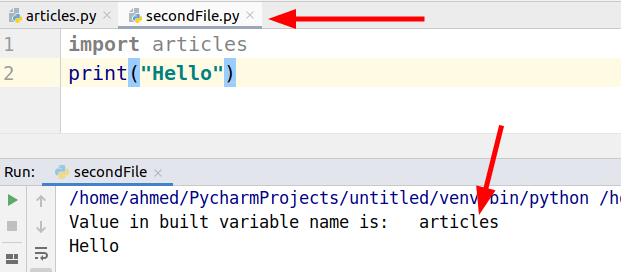
faqs
What is the purpose of the main() function in Python?
The main() function serves as the entry point for program execution, allowing for a structured and organised code flow.
How does the name variable work in Python?
The ‘name’ variable determines the context in which a script is run; it is set to ‘main’ when executed directly and to the module name when imported.
Can I call other functions from the main() function?
Yes, you can call other functions from within the main() function, allowing for modular code execution.
What happens if I do not include the if name == ‘__main__’: statement?
Omitting this statement will cause the main() function, and any code under it, to execute even when the script is imported as a module in another file.
Why is it important to use the main() function?
Using the main() function enhances code readability and maintainability, providing a clear entry point for execution and avoiding unintended script execution upon import.
Conclusion
The main() function in Python serves as an entry point for program execution, allowing for organized code structure and enhanced readability. By utilising the conditional statement __name__ == __main__, developers can control the execution of code within a module, distinguishing between direct execution and importation into other files. This functionality is essential for creating reusable and maintainable code in larger projects.