Introduction
Are you gearing up for a Full Stack software engineer interview? Preparing for these interviews can be challenging, given the vast range of skills required. Full Stack developers need to be proficient in both front-end and back-end technologies, as well as have a solid understanding of databases, version control, and more. In this blog post, we’ll cover essential interview questions that every Full Stack developer should be prepared to answer, including the Full Stack Software Engineer Interview Questions, along with tips on how to tackle each question confidently. Additionally, we will explore common pitfalls to avoid during the interview process. The Full Stack Software Engineer Interview Questions can significantly impact your success.
What is Full Stack Development?
Definition: Full stack development involves working on both the front-end (client-side) and back-end (server-side) of web applications. A full-stack developer has the versatility to create, deploy, and maintain the entire technology stack, from designing user interfaces to managing databases.
Why It Matters: Employers value full-stack engineers for their ability to oversee a project from start to finish, reducing the need for specialized teams.
Core Front-End Skills
HTML/CSS
Interview Question: “What distinguishes classes from IDs in HTML/CSS?”
Answer Tip: Discuss the specificity of selectors, their use cases in styling elements, and how they affect the DOM.
JavaScript Frameworks
Interview Question: “What are the advantages of using React over traditional JavaScript?”
Answer Tip: Highlight React’s component-based architecture, virtual DOM, and the benefits of one-way data binding.
Responsive Design
Interview Question: “How do you ensure that your web applications are mobile-friendly?”
Answer Tip: Discuss the use of media queries, responsive units (like em and rem), and frameworks like Bootstrap to ensure accessibility across devices.
Core Back-End Skills
Node.js
Interview Question: “Why would you choose Node.js for server-side development?”
Answer Tip: Explain the non-blocking I/O model, its scalability, and the advantage of using JavaScript for both front-end and back-end development.
Python/Ruby/PHP
Interview Question: “Compare Python with PHP for web development.”
Answer Tip: Discuss Python’s simplicity, readability, and large community support versus PHP’s robust web development tools and wide hosting compatibility.
Database Management
Interview Question: “What are the differences between SQL and NoSQL databases?”
Answer Tip: Discuss the structured nature of SQL databases, the scalability of NoSQL databases, and when to use each type based on the project requirements.
Remember that the Full Stack Software Engineer Interview Questions are designed to evaluate your proficiency across multiple domains. Emphasize your versatility and readiness to tackle challenges.
Common Interview Questions
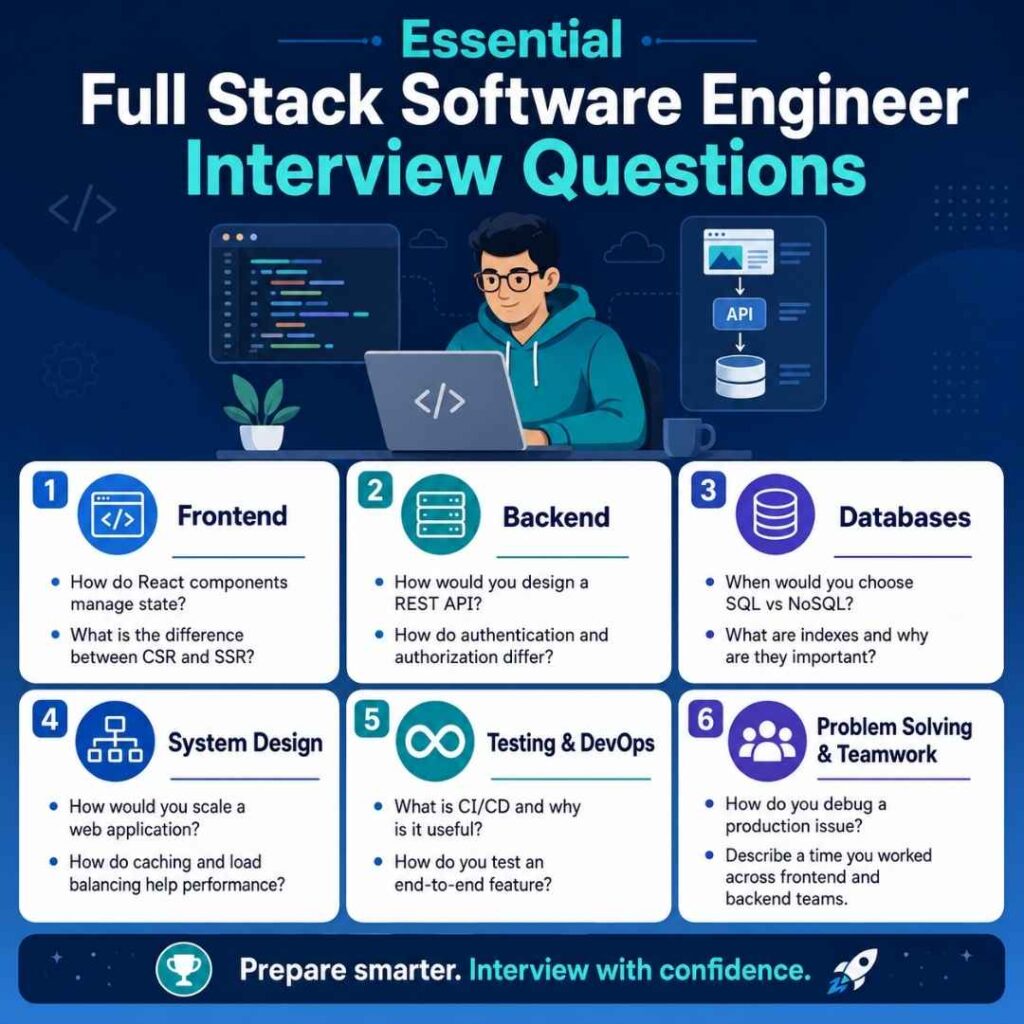
As you prepare for your interview, consider the Full Stack Software Engineer Interview Questions that are commonly asked. This preparation can give you an edge over other candidates who may not be as familiar with the breadth of topics that can be covered.
Front-End Questions
Question: “What strategies would you use to improve a website’s loading speed?”
Answer Tip: Mention techniques such as lazy loading, minification of CSS and JavaScript, optimizing images, and using content delivery networks (CDNs).
When discussing back-end solutions, don’t forget to reference the Full Stack Software Engineer Interview Questions relevant to back-end technologies. Being knowledgeable in both areas is essential.
The Full Stack Software Engineer Interview Questions can cover a multitude of topics, so make sure you’re well-rounded in both front-end and back-end skills.
Consider incorporating your experiences related to the Full Stack Software Engineer Interview Questions into your responses. This can help illustrate your hands-on knowledge and expertise.
Being well-prepared for the Full Stack Software Engineer Interview Questions can set you apart from other candidates. Ensure you practice articulating your thought process effectively.
Back-End Questions
Question: “Explain the concept of RESTful APIs.”
Answer Tip: Describe REST principles like statelessness, resource representation through JSON/XML, and the use of HTTP methods like GET, POST, PUT, and DELETE.
Database Questions
Question: “How do you prevent SQL injection attacks?”
Answer Tip: Discuss the importance of prepared statements, parameterized queries, and the principle of least privilege in database management.
Behavioral and Situational Questions
Question: “Describe a time when you had to troubleshoot a complex issue in a web application.”
Answer Tip: Use the STAR method (Situation, Task, Action, Result) to structure your response. Showcase your ability to solve problems effectively and handle stress.
In conclusion, mastering the Full Stack Software Engineer Interview Questions can significantly enhance your interview performance. Approach these questions with confidence, and you will increase your chances of securing the position.
Question: “How do you manage and prioritize tasks when juggling multiple projects?”
Answer Tip: Talk about tools like Trello or JIRA, and methods such as the Eisenhower Matrix, to prioritize tasks based on urgency and importance.
Final Tips for Interview Success
Understanding the Full Stack Software Engineer Interview Questions is crucial for anyone looking to succeed in these roles. Make sure to practice responding to these questions in a way that not only showcases your technical skills but also demonstrates your problem-solving approach.
Know Your Basics: Review core concepts in both front-end and back-end development.
Practice Coding: Use platforms like LeetCode and HackerRank to hone your problem-solving skills.
Stay Updated: Technology evolves rapidly. Keep up with the latest trends in full-stack development, such as new JavaScript frameworks or emerging database technologies.
Mock Interviews: Practice with peers or use online services to simulate real interview conditions.
Conclusion
Full-stack software engineering interviews are comprehensive and require a deep understanding of multiple technologies. By preparing with these questions, you’ll be better equipped to demonstrate your expertise and stand out from the competition. Remember, confidence is key practice your answers, stay calm, and showcase your passion for coding.
Key Takeaways
Full Stack Software Engineer Interview Questions:
- Understand the most common Full Stack Software Engineer Interview Questions.
- Prepare for frontend and backend development topics.
- Review JavaScript, React, Node.js, APIs, and databases.
- Practice coding and problem-solving questions.
- Learn basic system design and scalability concepts.
- Prepare examples from your real-world projects.
- Be ready for both technical and behavioral interview questions.
FAQs: Full Stack Software Engineer Interview Questions
1. What are the most common Full Stack Software Engineer interview questions?
Common questions cover HTML, CSS, JavaScript, React, Node.js, databases, APIs, Git, system design, and problem-solving.
2. How should I prepare for a full stack software engineer interview?
Review frontend and backend concepts, practice coding problems, build projects, and prepare for system design and behavioral questions.
3. What technical skills are tested in a full stack interview?
Interviewers may test JavaScript, frontend frameworks, backend development, SQL/NoSQL databases, REST APIs, Git, and cloud concepts.
4. Are full stack interview questions different for freshers and experienced developers?
Yes. Freshers usually face fundamental technical questions, while experienced candidates may be asked about architecture, scalability, performance, and real-world projects.
5. What coding questions are asked in full stack interviews?
Common topics include arrays, strings, objects, algorithms, data structures, API development, debugging, and practical coding tasks.